Not with us yet?
Sign up to access all site features.
Sign Up02.07.26
Just a few years ago, a Telegram invite was often perceived as a simple, mechanical process: build a database, upload accounts, launch the add-on, and watch the group grow. In 2026, this logic hardly applies.
Telegram has long ceased to be a platform where mass actions occur without context. The platform takes into account user privacy, account history, sudden spikes in activity, complaints, the quality of contacts, and behavior within groups. Therefore, the problem with low conversion is often not the invite itself or a specific button within the software. The problem is that the invite is launched too early: before audience filtering, before restrictions are checked, before accounts are warmed up, and without proper infrastructure.
As a result, businesses face a familiar scenario: a large database, few signups, numerous complaints, and some accounts quickly hit with restrictions. While it may seem like "Telegram is simply cutting off the invite," in reality, the entire process is disrupted.
In this article, we'll examine the main mistakes made when building an audience on Telegram and demonstrate a modern process: from collecting an active database and preparing accounts to targeted invitations, communications, and analytics. As an example of a comprehensive tool, we'll use Telegram Expert —a platform that integrates account management, audiences, proxies, invites, mailings, and reporting in a single interface.
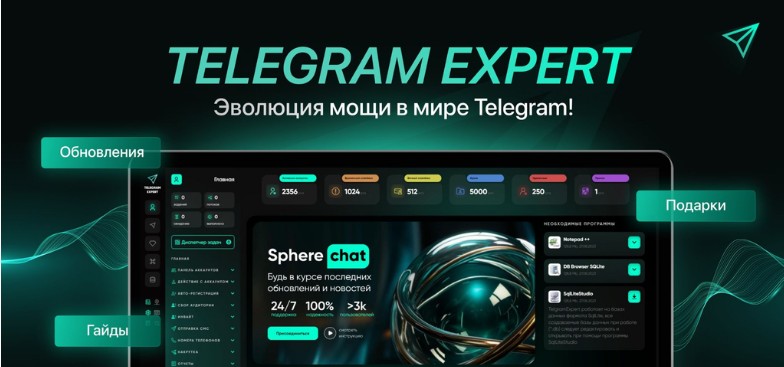
The most common mistake when inviting on Telegram is to focus on quantity. The larger the base, the better: 50,000 users, 100,000 users, a "live audience" from a competitor's old chat, or a purchased list of numbers.
In practice, a large database says almost nothing about its quality. It may contain inactive accounts, people with no interest in the topic, users from other geographies, duplicates, closed profiles, accounts with restricted privacy, and those who haven't interacted with thematic chats in a long time. Technically, the database exists, but to Telegram, it looks like a cold list of random people.
This is where the first problem arises: the invite is launched not at the audience, but at a random group. The user doesn't understand why they're being added, doesn't see the connection with their own interests, and is highly likely to ignore the invitation, leave the group, or file a complaint.
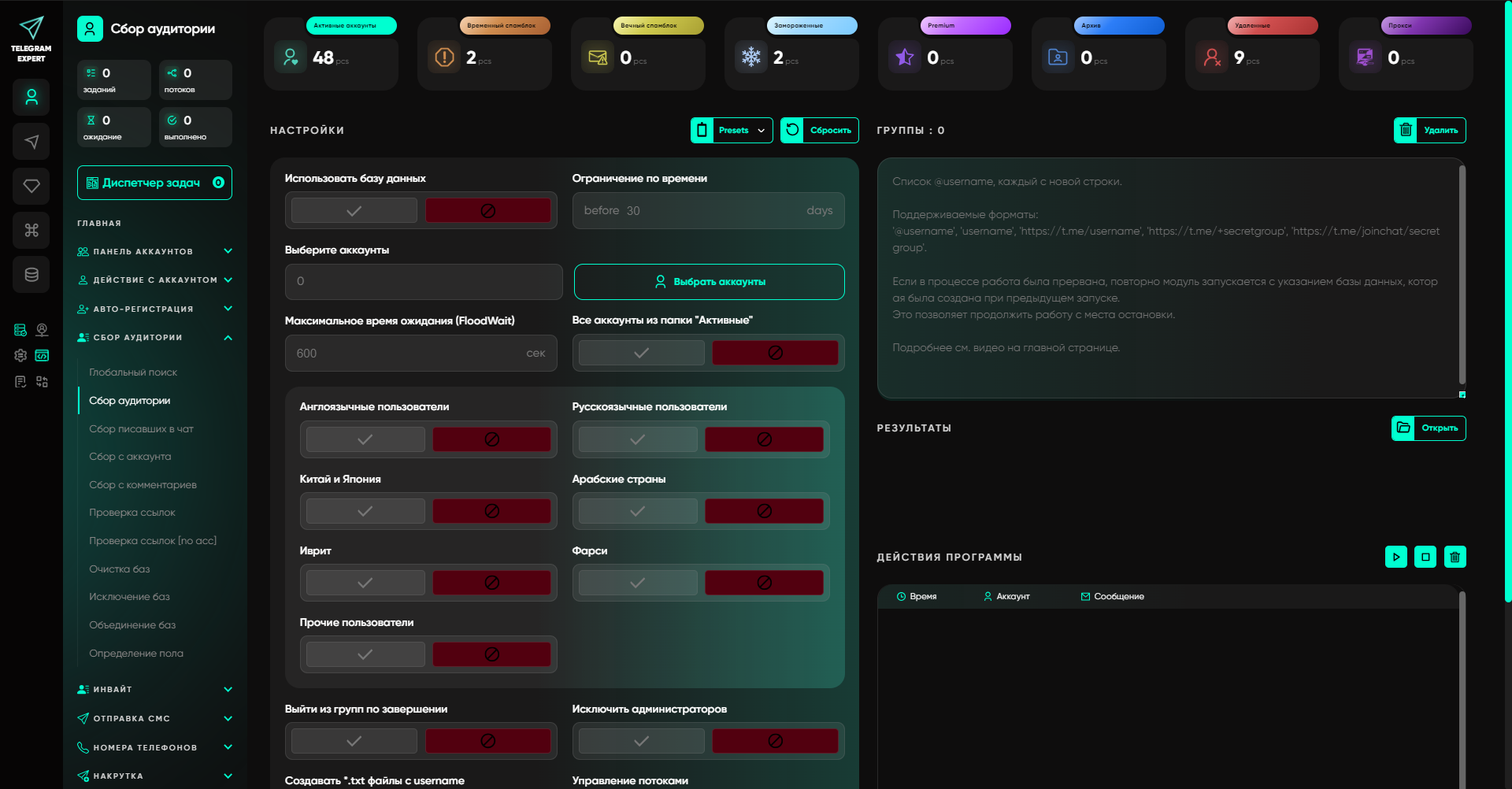
The right approach starts not with an invite, but with selection. It's not just every competitor's follower that's important, but those who have already been active: posting in chats, leaving comments, participating in discussions, and recently appearing in the relevant field. Such users have already demonstrated a basic interest in the niche, meaning their response to the invitation will be quite different.
Telegram Expert uses audience collection modules for this purpose. For example, you can collect users who posted in a selected chat during a specific period, extract commenters from channel posts, or use Telegram's global search if there are no direct competitors. Afterwards, you can clean up the database, combine it with other samples, eliminate duplicates, and filter out irrelevant segments.
This changes the very logic of the work. Instead of "collect as many as possible and try to add everyone," a proper funnel emerges: find active users, clean the database, check its quality, and only then decide who is really worth inviting.
In 2026, an invite doesn't function as a mass mailing to random people, but as the final step after audience preparation. The warmer the base, the fewer complaints, the lower the load on accounts, and the higher the chance that a new member will not just join but stay in the group.
The second mistake is assuming that if a user is in the database, they can simply be added to a group. In older systems, Telegram was often treated like a contact list: find the username, load it into the software, and initiate an invite. This logic is now too crude.
Telegram has its own limitations, some of which aren't visible externally. Users can prevent others from joining groups through their privacy settings. An account may be unavailable for invitations if there's no clear connection between it and your account: a shared chat, contact, conversation, or other point of contact. The group itself may also not be ready for manual addition, especially if it has already outgrown the initial stage and needs to grow through links, requests, and external sources.
Therefore, an invite may be formally launched, but in reality, it yields no results. The software works, accounts make attempts, the database is depleted, and there are almost no sign-ups. In the worst case, instead of growth, you get complaints, restrictions, and the loss of working accounts.
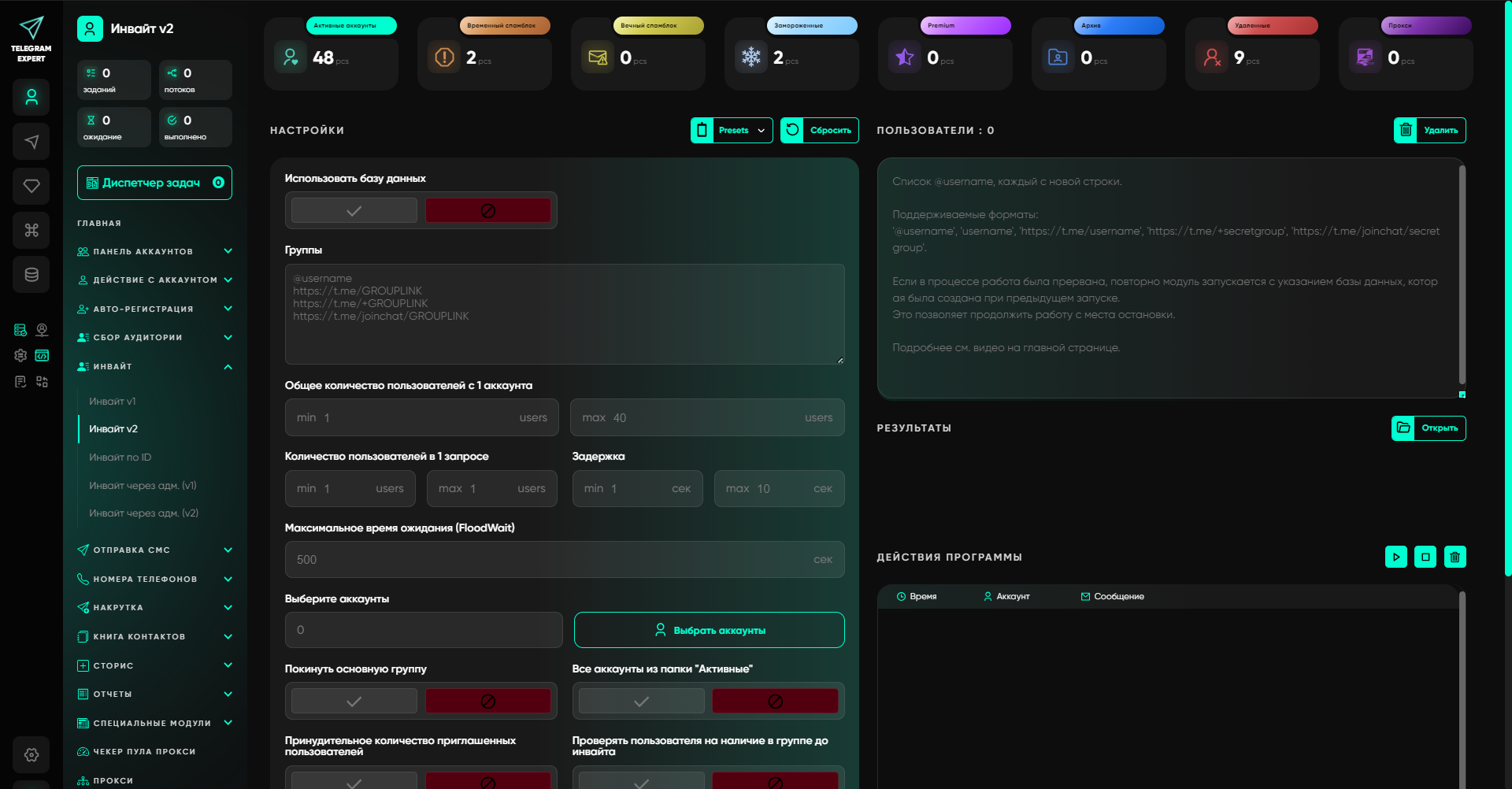
Before launching, you need to check not only the audience but also the technical requirements: are links accessible? Do chats and channels exist, how many members are in them? Is it possible to work with the selected group? Are there any obvious user or source restrictions? Telegram Expert uses link verification modules for this: through selected accounts, without accounts, or through a proxy.
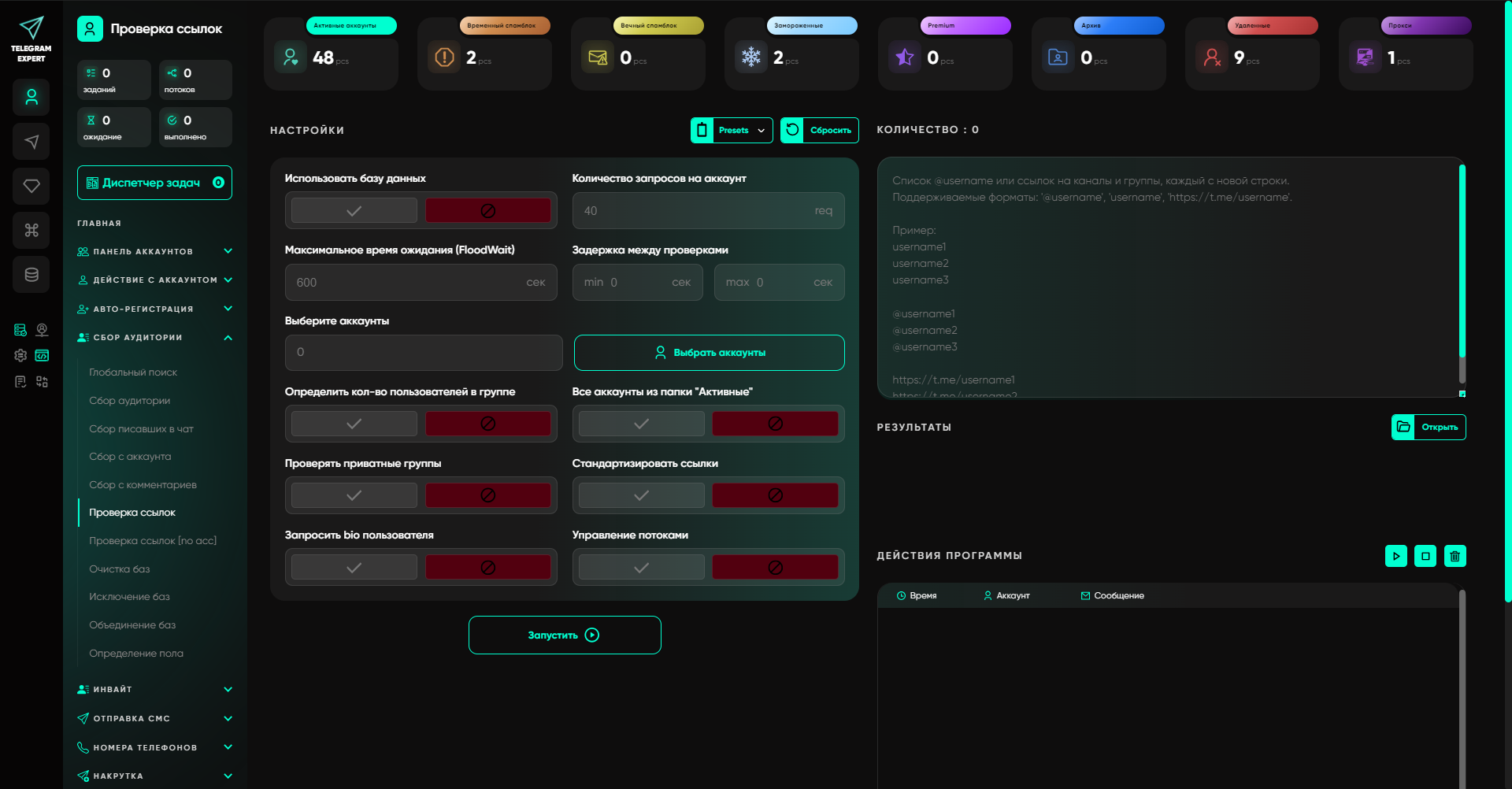
This step isn't as impressive as the invite itself, but it saves resources. This check shows in advance where it's worth continuing work and where attempts will be wasted. In modern Telegram automation, this is a mandatory part of the process: first, check the rules and availability, then take action.
Even a high-quality database won't save you if unprepared accounts are using it. For Telegram, it's not just the invitation itself that matters, but also the context: how long the account has been in existence, what it looks like, whether it has a history of normal activity, contacts, conversations, subscriptions, and consistent behavior.
An empty account with no profile picture, description, contacts, or previous activity appears weak. If it's used to initiate a series of similar actions, the system quickly sees a stark contrast: yesterday, the account was doing almost nothing, today it's actively adding people or messaging strangers. For antispam, this is one of the most obvious risk signals.
Therefore, account preparation is not a decorative step. It is necessary to ensure that production accounts don't look like disposable technical profiles. They must have basic data, a normal distribution of statuses, a clear activity history, and a manageable workload.
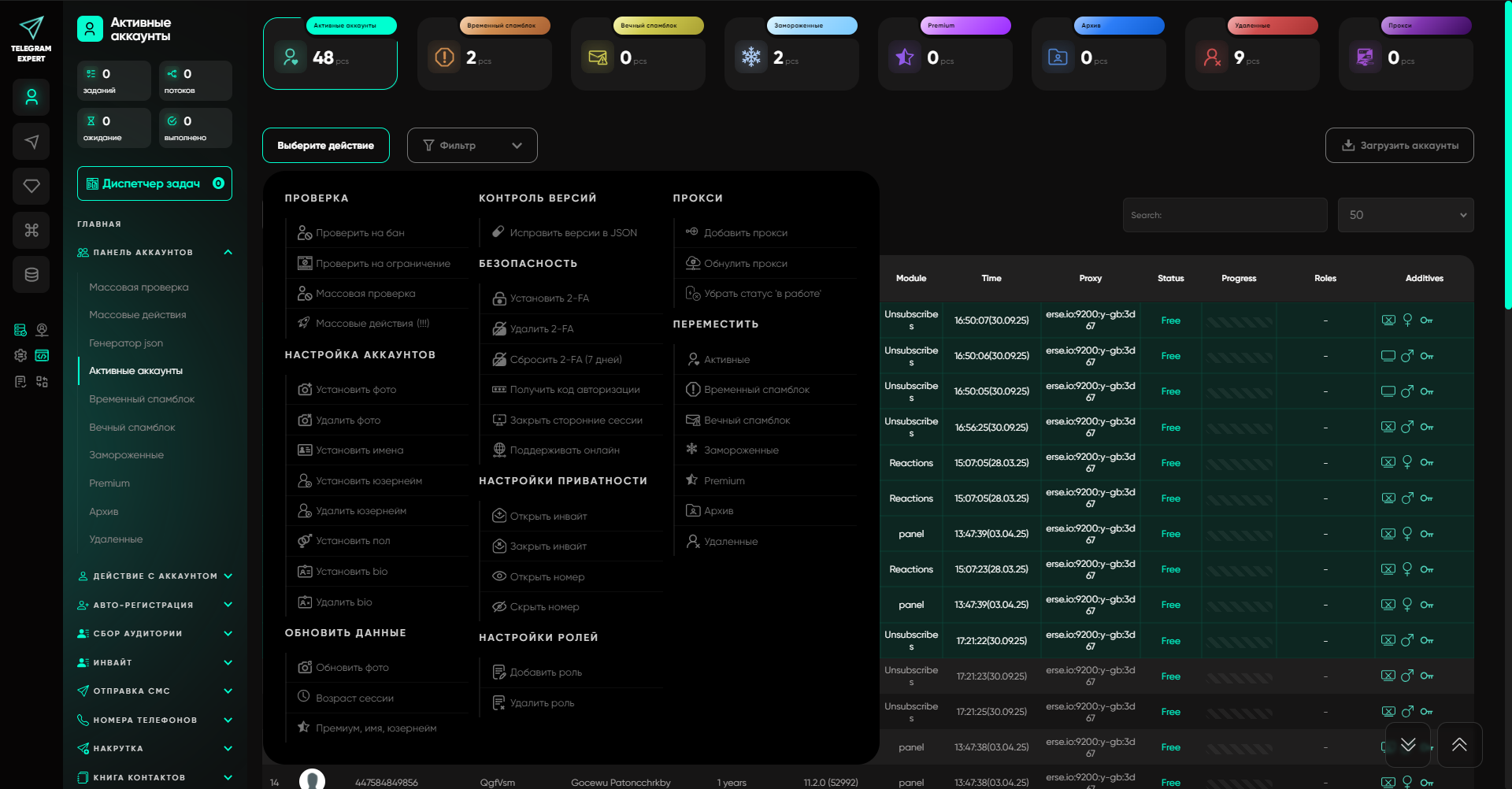
In Telegram Expert, this section is accessible through the accounts panel and bulk actions. The panel shows which accounts are active, which have been temporarily or permanently restricted, and which are archived, frozen, or in a separate workgroup. Bulk actions allow you to centrally update profiles, manage settings, and manage accounts, eliminating the need to perform each operation manually.
The main goal here isn't to "build trust," but to avoid launching sensitive operations from a chaotic and unprepared infrastructure. Before inviting, accounts must be verified, distributed, and brought to a working state. Otherwise, an invite turns not into a growth tool, but into a quick way to lose some accounts.
When working with Telegram, people often discuss databases, accounts, and invites, but forget about the infrastructure. This is a mistake. If accounts operate through unstable proxies, overlapping IP addresses, or inappropriate network parameters, the risks increase even before active operations begin.
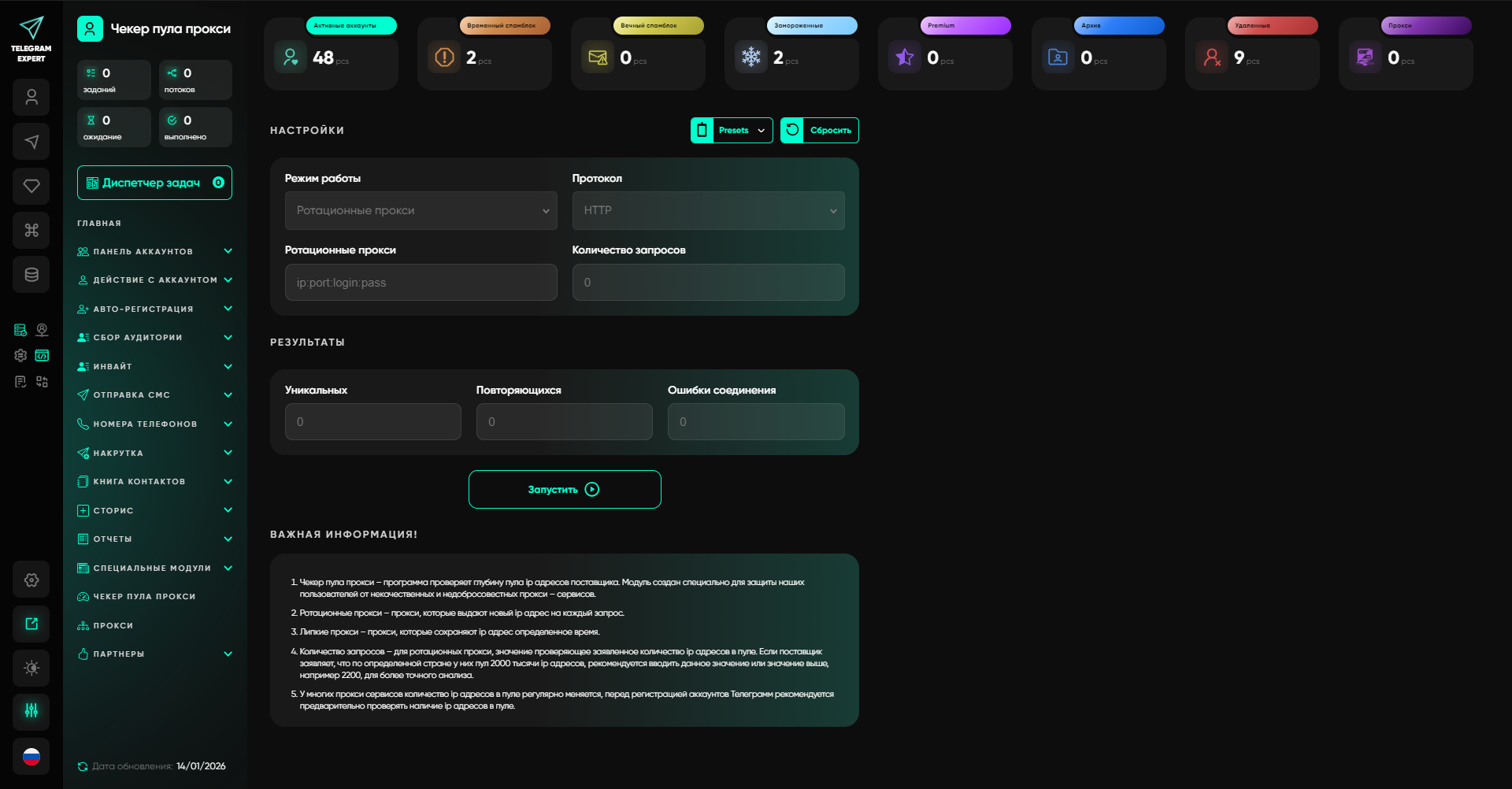
Telegram sees not only what an account is doing but also the technical context: where it's connecting from, how stable the session is, whether the environment is changing too abruptly, and whether the same network footprint is appearing across multiple accounts. Therefore, when working at scale, it's important not just to "install any proxy," but to monitor the pool, speed, availability, and IP overlaps.
The problem is especially noticeable when all accounts are formally prepared but operate through a weak infrastructure. Some sessions may drop, some actions fail, and some accounts are exposed to additional risks due to identical or unstable connections. Ultimately, it appears that the problem lies with the invite, when in fact, the chain is broken at the network level.
Telegram Expert provides dedicated tools for this: adding and checking proxies, as well as a proxy pool checker. This helps analyze IP address overlaps and understand how cost-effective and safe it is to use the current pool for large-scale operations. You can also check proxy quality using our proprietary tool , Detect.Expert. It allows you to quickly test a list of proxies, assess their availability and operational status before launching tasks, helping to proactively identify problematic connections and mitigate risks associated with unstable infrastructure.
For Telegram automation, infrastructure isn't a minor setting, it's the foundation. If accounts, databases, and scripts are properly prepared, but the network layer is chaotic, the resulting stability will still be low. Therefore, before launching an invite, it's important to check not only the people and accounts, but also the technical foundation they operate on.
The main misconception surrounding Telegram invites is that they're viewed as a standalone growth channel. It seems like all you need to do is build a database, upload accounts, and start inviting users. But in 2026, this approach almost always yields poor results.
An invite doesn't replace content, community, advertising, collaborations, or external traffic sources. It works selectively: it helps reach a group of people who have already shown interest in the topic, contacted you, posted in similar chats, commented on relevant posts, or are part of a well-prepared database.
Using an invite as the first step quickly devolves into coldly adding strangers. This reduces conversion, increases the risk of complaints, and creates unnecessary strain on accounts. However, if you launch it after collecting, filtering, verifying, and preparing accounts, it becomes part of a proper funnel.
Telegram Expert offers several invite scenarios for this: classic username invitations, ID-based invites, user verification before adding, and options through the admin system. However, the choice of a specific method is secondary. It's more important to understand that an invite should only be launched once the audience, accounts, group, and infrastructure are ready.
Results shouldn't be measured by the number of attempts. It's more important to look at how many users joined, how many stayed after a few days, and how many started reading, writing, or reacting. Massive additions for the sake of numbers quickly lose their meaning if new members don't become a vibrant part of the community.
Another mistake is to consider the work complete once the invite is launched. In practice, it's only after the launch that it becomes clear how well the entire chain was assembled.
Looking only at the number of invitations will distort the picture. You might make many attempts but get few engagements. You might get engagements but then see massive exits a few days later. You might overload accounts but not notice that some of them are starting to receive restrictions. Without analytics, such issues appear random, when in fact, they reveal a weak point in the process.
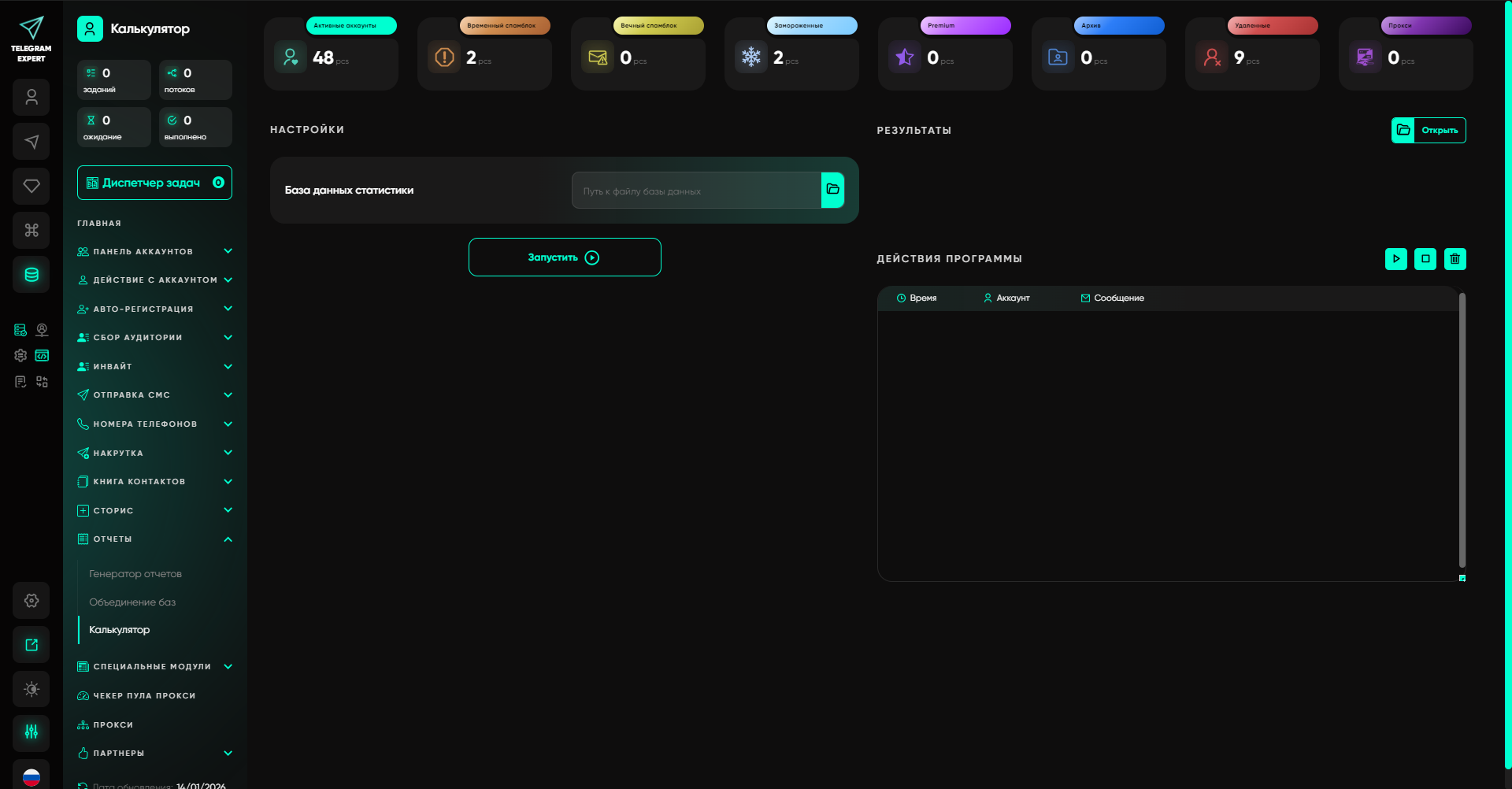
It's important to evaluate not only the volume of actions, but also the quality of the results: how many users actually joined, how many remained in the group, how many started writing or responding, which accounts produced the best results, where restrictions were introduced, which databases performed best, and which resulted in complaints or empty attempts.
Telegram Expert has a reporting module for this purpose. It allows you to collect data on completed actions, combine results from different tasks, and calculate account load. This eliminates guesswork as to why an invite wasn't successful, and instead allows you to pinpoint specific issues: a weak database, an inappropriate method, overloaded accounts, poor infrastructure, or an incorrectly targeted audience.
Without analytics, Telegram promotion becomes a series of guesses. Analytics provides a manageable process: you can test different segments, compare approaches, mitigate risks, and gradually improve audience quality, rather than simply repeating the same scenario with a new base.
A Telegram invite in 2026 isn't a standalone button for rapid growth, but the final step in a larger chain. First, you need to build an active audience, clean up your database, check restrictions, prepare accounts, set up infrastructure, and only then launch targeted invitations.
The main mistake is starting with action, not preparation. This is why many people experience low conversion rates, complaints, and account restrictions. Telegram directly limits unwanted messages and links to unknown users, so sustainable results are only possible with a relevant audience, a controlled workload, and clear analytics.
In this logic, Telegram Expert acts not just as an inviter, but as a full-service system: accounts, databases, proxies, verification, invitations, communication, and reports are all in one interface. This eliminates the need to jump between different tools and allows for a comprehensive overview of the entire process—from audience acquisition to results evaluation.

By clicking "Accept", you agree to this Detect Expert can use cookies to help personalize content.
You can always opt out by following guidelines in our Cookie Policy.


